





In recent years, we’ve witnessed rapid advancements in artificial intelligence technologies. From texts and illustrations to music and interior design—AI seems capable of doing it all. It might have even written this article (just kidding, of course). 😄
Some platforms can already generate room visualizations in seconds, suggest furniture, and choose color schemes. So, should designers start to worry?
AI Is Just a Tool, Not the Project’s Author
Today, artificial intelligence can do quite a lot: it generates beautiful images of children’s rooms in any style, suggests layouts—bed here, wardrobe there, desk by the window—and automatically selects color palettes or furniture based on given parameters.
It all looks impressive. But only at first glance.
Why Isn’t That Enough?
Yes, modern AI systems can:
✅ Generate interior sketches based on text prompts
✅ Select furniture and color schemes in a given style
✅ Offer basic room zoning suggestions
However, it’s important to understand that artificial intelligence lacks a full grasp of the real-world specifics of design projects. It doesn’t take into account:
❌ Precise room dimensions, niches, or floor level differences
❌ Complex layouts and engineering constraints
❌ Technical details like utility connections and implementation feasibility
❌ Fire safety, sanitary, and building regulations
❌ The real-life behavior of materials used in construction
AI has no idea what it means to “renovate a new-build apartment with no subfloor” or “fit a loft bed into a room with sloped ceilings.” But a human designer does.
AI vs. Designer: A Real-Life Challenge
We decided to put it to the test: can AI truly replace a children’s room designer? To find out, we took a typical request from parents and created a detailed technical brief—just like in a real project. We provided the AI with all the necessary information to develop the design, including the color palette, style, and functional zones.
Now, we’ll compare its solution to the traditional approach of a human designer to see whether AI can truly compete with the creative process of a professional.
Technical Brief
- Child’s age: 5 years
- Gender: boy
- Style: modern minimalism
- Room size: 12 m²
- Color palette: light blue shades
Functionality:
- two-level structure (sleeping area below, play area above)
- wardrobes and shelves for storage
- sports corner with rings and monkey bars
And here is the result:
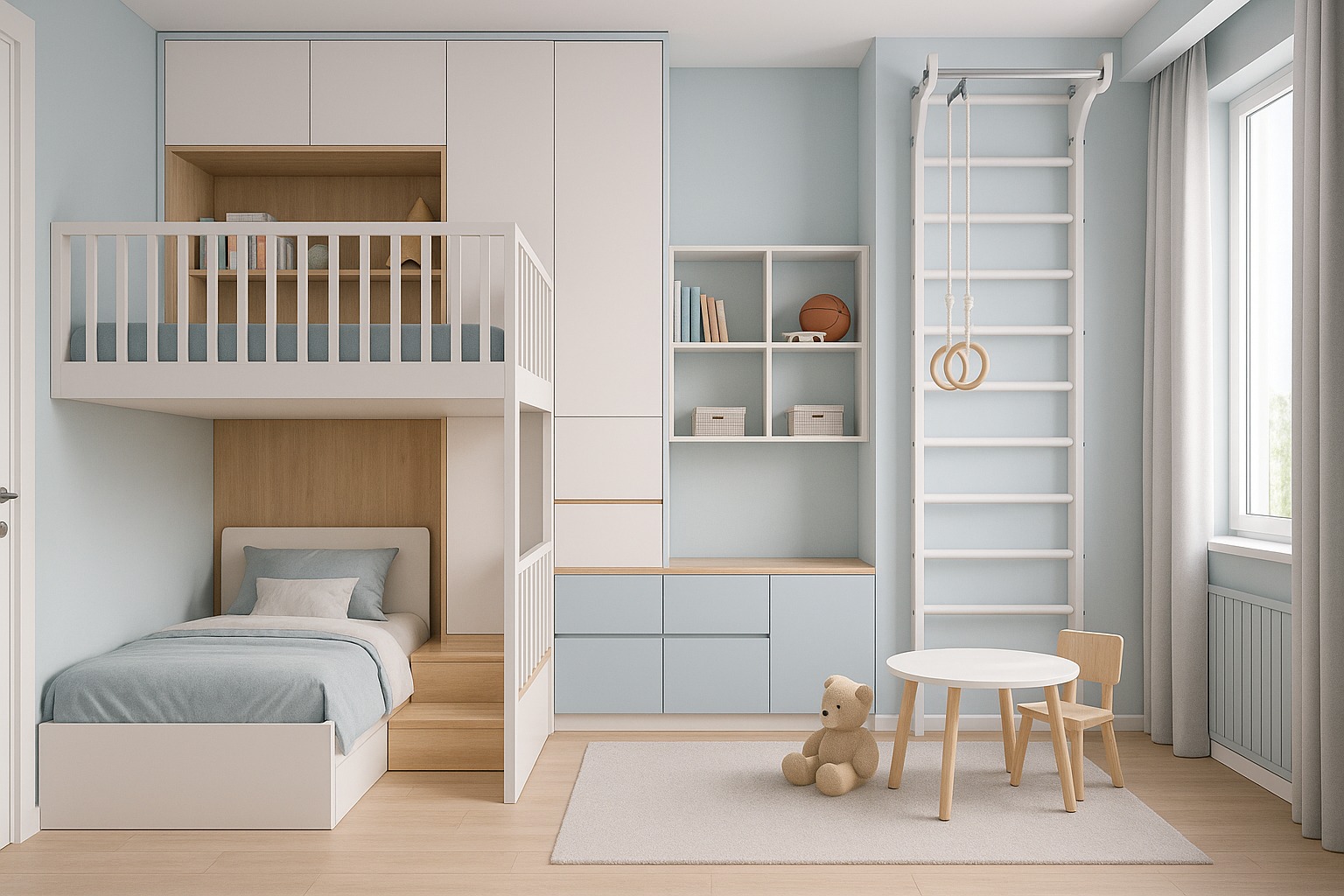
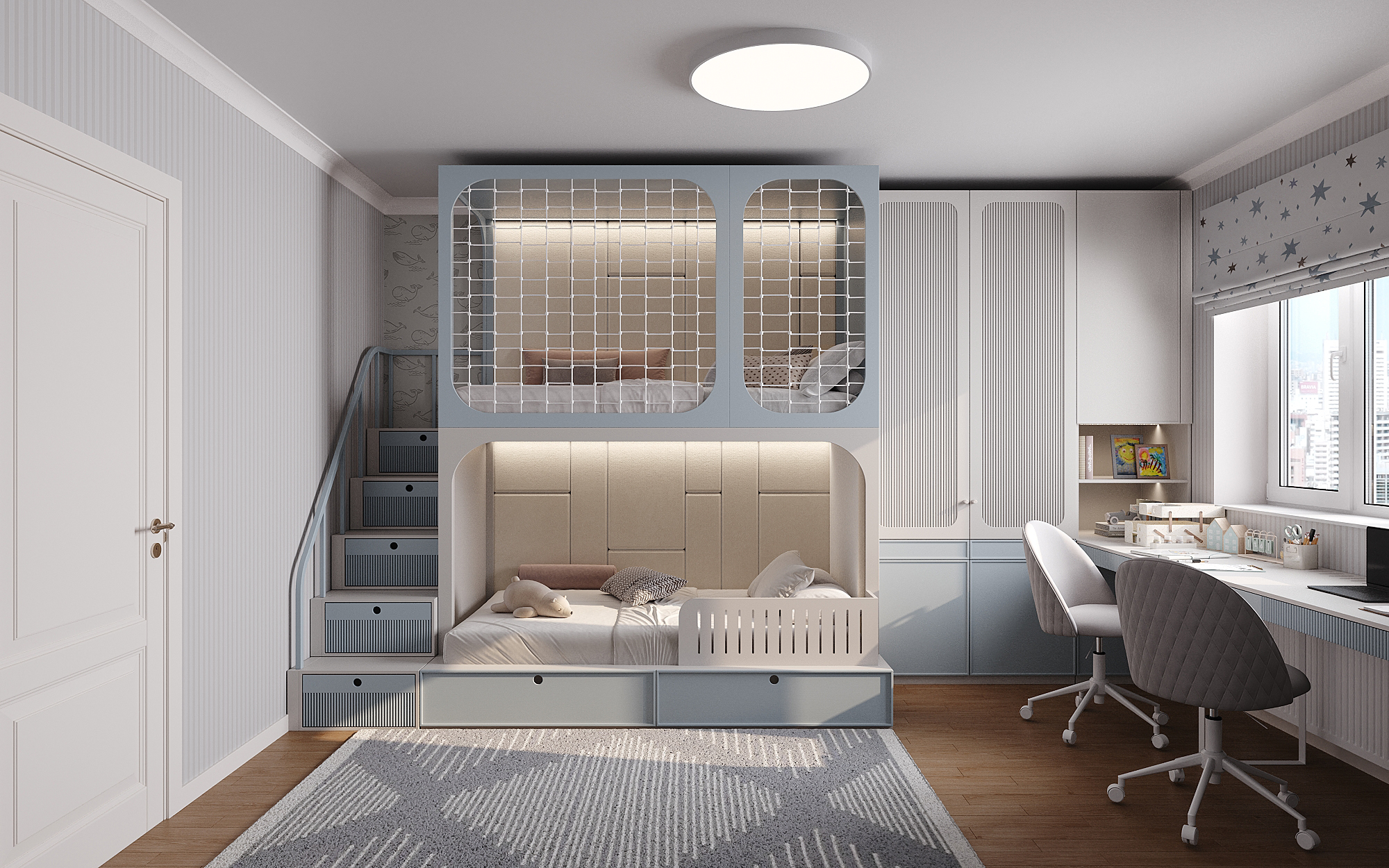
The first image was generated using artificial intelligence, while the second is a real visualization created by our designer.
Evaluation of Results
- Atmosphere and Aesthetics
AI generated a nice image with pleasant colors and trendy decor. However, it lacks individuality—the room looks like a template, without considering the child’s age, interests, or family style. In the designer’s visualization, the atmosphere feels “alive”: every element has its place and purpose, creating coziness and character.
- Functionality
AI is not always able to account for important proportions and the functionality of the room. For example, it may suggest furniture placement without considering factors like the direction of light or ease of access. In this case, AI ignored the fact that the child would have to climb stairs to reach the upper level of the bed. It didn’t consider how comfortable and safe these stairs should be for a child or how they integrate into the overall room layout. In contrast, the designer carefully thought about this aspect, considering safety, comfort, and ease of use, which is crucial in the functional design of a children’s room.
- Safety and Ergonomics
AI does not always account for furniture height, spacing between objects, or potentially hazardous corners. In the designer’s visualization, all these details are addressed: rounded shapes, easy access to everything, safe materials—everything in its place.
- Feasibility of Implementation
The image created by AI looks appealing but often unrealistic—it may contain furniture that isn’t available for sale or combinations of elements that are difficult to bring to life. The designer, on the other hand, works with specific materials, brands, and budgets, so the result is not just an image but a real plan for execution.
Conclusion: So, Who Wins?
AI is a great tool for finding inspiration, generating initial ideas, or quick visualizations. But it doesn’t account for the thousands of nuances, doesn’t take responsibility for the result, and can’t “feel.”
A children’s room designer isn’t just about a pretty picture. It’s about a home where a child grows, plays, learns, and feels safe. And here, replacing the human is impossible.

